

How to Remove Citristrip Residue from Wood Furniture
There is nothing more annoying in the DIY furniture makeover world than removing the gross sticky residue after using a chemical stripper on wood furniture. Choice words have been said around here.
Remember back when Robert and I stripped old paint from our fireplace mantle and I was in love with the Citristrip gel we used? The fresh citrus scent makes stripping paint so much more bearable than other types of paint strippers.

Well, that relationship has run its course and after this last furniture stripping project, it’s time for a breakup. Sorry Citristrip. It’s you, not me. And just like every difficult break-up, I turned to alcohol to get me through it. Denatured alcohol that is. (Har har. Come on now, this is a family-friendly blog.)
When to Use Citristrip
Citristrip CAN be the best way to remove oil-based paint or layers of dried latex paint from a piece of furniture. But sometimes you’re left with Citristrip residue that is extra stubborn to remove after taking off an old finish.
Yesterday I posted about my mid-strip progress, or lack thereof, and I finally had to call it a day after 24 hours of scraping the stubborn gummy residue that made a complete mess and still didn’t want to budge.
Citristrip did great on latex paint before, but it was no match for 40 year old varnish.
The Citristrip label said to clean up the residue with mineral spirits, but after hours of applying, scrubbing, and a few dollars shorter later, it still wasn’t much better.
However, I won the battle! So here’s how I fixed the issue.
Makeover: Designer Knock Off No Sew Dining Chairs

Most Effective Furniture Stripper
For removing oil-based paint and varnish, use Dumond Smart Strip instead. It is a much more powerful formula than Citristrip.
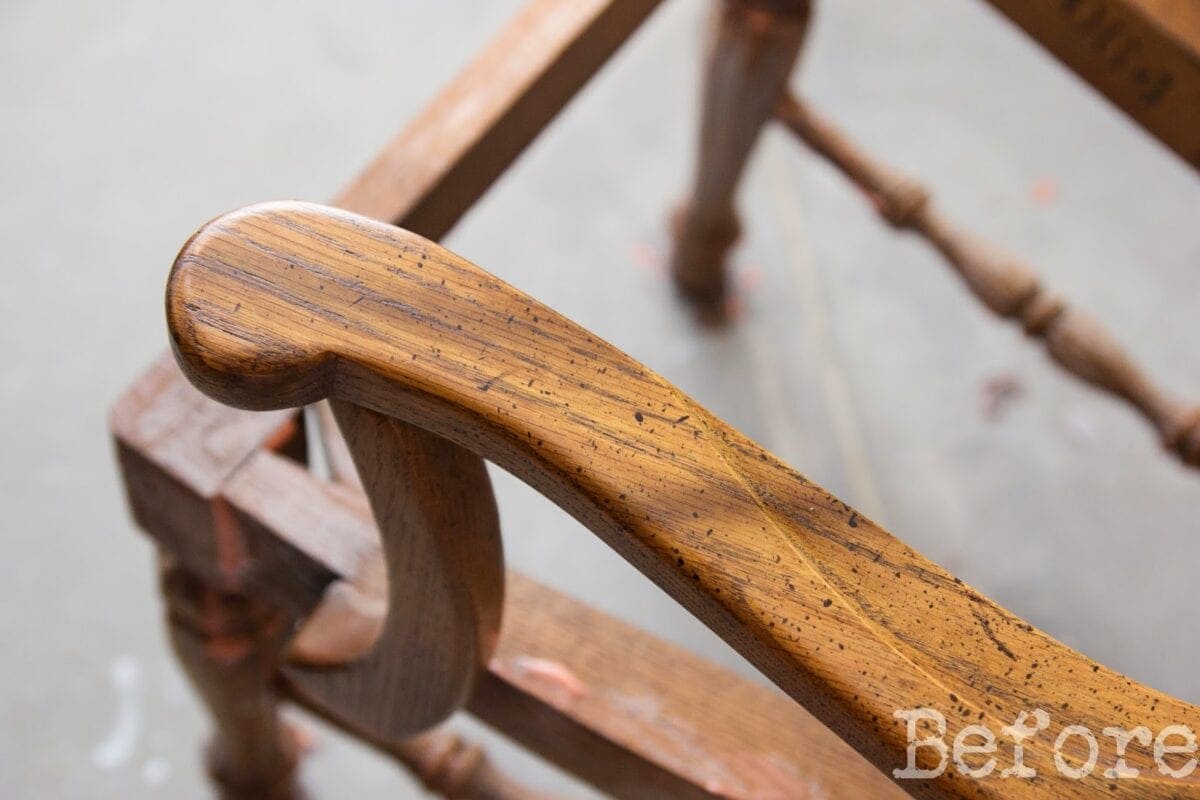
Here’s a shot of the chair legs right after applying the Citristrip. I was blissfully unaware at this point. I was so mad about the gummy gunk later that I didn’t even take a picture of it. Trust me on this one; it was bad.
Related: How to Refinish Wood Furniture Without Stripping

How to Remove Citristrip Dried Residue
I searched high and low through resource after resource to figure out the easiest way to fix the dried Citristrip disaster I created and came up with a few solutions but nothing that really worked.
Several sources I found said to try another coat or two of the varnish stripping gel. And my thoughts were “No freaking way! I can’t do it again. I need a shortcut.” (Shortcuts usually lead to more disaster when it comes to home improvement, but I proved that lesson wrong in this scenario…thankfully.)
I reached the point where I didn’t even care that the furniture still had some leftover stain and varnish. I just wanted the residue gone so that I could prime and be done with it. So if you find yourself in a gummy, gunky stripping mess like I did, here is the solution that I figured out through trial and error.
The answer to my Citristrip disaster:
Denatured Alcohol!

Check out that beautiful gunk-free wood! Mineral spirits didn’t work. Goof off didn’t work. Goo Gone didn’t work. Sanding didn’t work. Hot water made it stickier. Additional stripper just caused a bigger mess (these chairs had a LOT of varnish).
But when I swiped on the denatured alcohol, I could almost hear angels singing. It was the best result. Saying a little prayer for patience probably helped too.
So after a good wipe down of denatured alcohol and using steel wool on the flat surfaces and a small brass wire brush to work it in the little crevices, I finally saw light at the end of the tunnel.
To be safe since there are a few varnish spots still left, I’m giving the wood a coat of oil based primer, Kilz Original.
I’ve never been so happy to take an after shot in my life.
Related: How to Clean Wood Furniture to Make It Look New

How to Use Citristrip for Best Results
Here are some helpful tips to use Citristrip with good results next time:
- Protect your work area with a large drop cloth
- Wear protective gear such as safety glasses and chemical resistant gloves
- Apply a thick layer of Citristrip (don’t hold back)
- Cover the stripper with saran wrap and let it sit for at least 30 minutes
- Begin paint stripping with a plastic putty knife or plastic scraper
- Wipe away paint stripper residue with a paper towel or clean cloth
- Repeat the process with a second coat if needed when removing thick layers of paint
- Clean off remaining residue with odorless mineral spirits or Paint Stripper After Wash
I’m so glad to finally be done with that first step, but whenever I have a DIY fiasco happen, I have to look on the bright side that at least I learned a skill to always keep in mind for any other projects from here on out.


Bless you Lauren! I have been fighting all afternoon with a sewing cabinet (probably much like the one described above). We had gotten it from my mother in law many years ago, and I just wanted to give it a quick face lift, but after redoing the top and one of the panels in front, it looked so wonderful that I decided to go all out and take it down to the wood and really do it right. When I started the project, I just went over the two surfaces I was most interested in with a “mouse” sander and took it down to the wood, but while at the store getting additional stains, I got sucked in to doing it “right” and stripping the finish off. Having plenty of outdoor space to work in, I bought the hard core, big nasty chemical variety. Trust me, CritiStrip is not the only culprit in the goo game! It bubbled and boiled like I thought it was supposed to, but turned into the stickiest, stubbornest, boil your skin in a split-second mess that can be imagined! No amount of brushes, steel wool, elbow grease, tears, etc. will separate it from it’s host. I’m far too exhausted tonight, but first thing in the morning, I’m heading back to the store, walking with blinders past all the distracting “great ideas” and buying a large container of denatured alcohol, thanks to you! (Well, I might get a few packages of sandpaper for my mouse, cause that’s the only way I’m taking any finishes off in the future!) Thank you so much!
Thank you! You are an angel! I haven’t tried the denatured alcohol but I’ve tried every one of the other things you had tried before the denatured alcohol. Just your sharing is a blessing in itself because I had no idea what to try. So off to the store I go.
Yay! Hope it works out!
I’m glad I found this post. I have a CitriStrip mess on my front porch in way of a chest of drawers I’m redoing. I’m totally exhausted from the mess. My niece used the CS on her kitchen cabinets and she loved it that it did a phenomenal job. So tomorrow I’m going to pick up the denatured alcohol and pray I can get this thing finished. It’s a beautiful solid oak piece. So I’m praying it works so I can get it done & get on with life inside the house on projects I need to finish. Thanks for everyone who has posted. I’m just praying this other will work. Otherwise, I have a gummy mess all over the boxes & rags that need to be thrown out. 🙂 Possibly the chest, but I hope not.
Ack! It’s the worst and I completely feel your pain. Hope it works out!
We have a stair case banister that has about a million coats of paint, and it’s now just a big CitriStrip mess of goo. We are trying the denatured alcohol, but so far it’s not much help. Does letting it sit before scraping/scrubbing help?
Oh no! You can maybe try a different brand of paint stripper. I’ve been discovering that CitriStrip seems to be the biggest culprit.
I literally came across this by accident. What a blessing. I have been fighting with a bathroom window all week. The only way I can describe it is melted chewing gum. I am leaving to get some alcohol right now. Thank you! Carolyn
Ugh! Yes! That’s exactly what it’s like. Glad it helped though!