

Easy DIY Wood Stain Using Vinegar and Steel Wool
How to make gorgeous aged wood stain with simple ingredients from your pantry and without the price tag and hassle of store bought wood stain.
If you are trying to reduce the cost of your home improvement supplies or want to swap harmful chemicals for natural solutions in your home, this DIY wood stain recipe is definitely for you.
I unlocked the code to finding the best natural wood stain, and it is AWESOMESAUCE! (Do we still say that word?)
If you have ever appreciated the look of aged wood, this recipe will teach you how to recreate the look on new wood by combining strong black tea with a vinegar solution and steel wool mixture for a chemical reaction that naturally darkens unfinished wood.
I conducted a little experiment in my kitchen on our bathroom plank wall project.

And I discovered that I am never going back to store-bought wood stains for as long as I can help it. This method rocked my world, y’all!
I’d heard about several variations of wood oxidation before to create a color change on different types of wood, so I put them to the test to find that perfect barnwood finish with this tried and true homemade wood stain.
It took all of 30 minutes of “labor”, was really easy clean-up, didn’t require the use of any harsh synthetic chemicals, and only cost me $5 since most of what I needed was already hanging out in my pantry.
Boom, baby! That’s what I’m talkin’ about.

Perfecting the Color of Natural Wood Stain
Going into this little experiment, I knew I was looking for the end result of a rich color wood tone with a little hint of gray blue color.
On a scrap test piece of wood, I tried all kinds of vinegar recipe combinations for a couple days by mixing steel wool grades and types of vinegar, and discovered that 0000 grade steel wool is the best for the impatient DIYer who doesn’t want to wait a couple of weeks to do this.
Homemade Pre-Stain Conditioners
Applying a wood conditioner pulls the natural tannins to the surface of your raw wood. The kind of wood you choose will determine the color. Heavy-tannin woods like oak or walnut will natural show a darker color than lighter-tannin woods like pine or poplar. So it’s a good idea to test your homemade stain on a scrap piece of wood before working in larger areas.
- Brewed tea
- Coffee
Vinegar Method
You can attempt this vinegar stain with different types of ingredients on any type of wood to find the best way to achieve the color of the wood you want.
- White vinegar
- Red wine vinegar
- Apple cider vinegar
- Balsamic vinegar
In my experiment, apple cider vinegar gave a more gray tint than white distilled vinegar.
Brushing wood with coffee brings out more of the brown tones of wood while black tea brings out the gray.
In the end, this was the winning method for me.
DIY Natural Wood Stain
Ingredients to Make Natural Wood Stain
- 2 cups of boiling water
- 4 family size black tea bags (I used these Luzianne tea bags if you want to be really specific.)
- 1 real steel wool pad of 0000 grade (I use these.)
- 2 cups of vinegar (White House brand apple cider vinegar to be exact.)
- 2 cheap chip brushes or foam brush
- glass jar
- Medium grit sandpaper
- Pieces of wood of your choice (pallet wood is great to use for this)
WORK SPACE: Be sure to wear gloves and protect your work area with waterproof drop cloths.

Step 1 – Sand
Lightly sand the wood surface with medium grit sandpaper and remove any dust so it will take the stain more evenly.
Step 2 – Make Wood Conditioner
To prep the wood conditioner, I let 4 black tea bags steep in the 2 cups of boiling water for 24 hours to make it really strong (I left the tea bags in the entire time).
Step 3 – Mix Vinegar and Steel Wool Stain
For the oxidizing stain, I combined the steel wool pad and vinegar in a large glass jar and let it sit for 24 hours too.
IMPORTANT: Leave the jar uncovered as the homemade stain will release gas that shouldn’t be covered.
Then the fun began!

Step 4 – Apply Conditioner to Wood
After 24 hours, when I was ready to stain, to pull the tannins out of the wood, I brushed it all down with the cold tea mixture and let it sit for an hour.

(Below) The left 3 planks are plain and the right 3 planks are brushed with the tea.

Step 5 – Apply Stain
After the hour mark, I brushed the wood with the steel wool / apple cider vinegar mixture, and it instantly turned gray. I was nearly jumping up and down with excitement. (I get excited over things that many “normal” people would probably think is crazy.)
The best part is watching the magic happen after this step.

5 minutes later, the color deepened and I knew it was going to be gorgeous!

After 15 minutes…

…and 30 minutes…


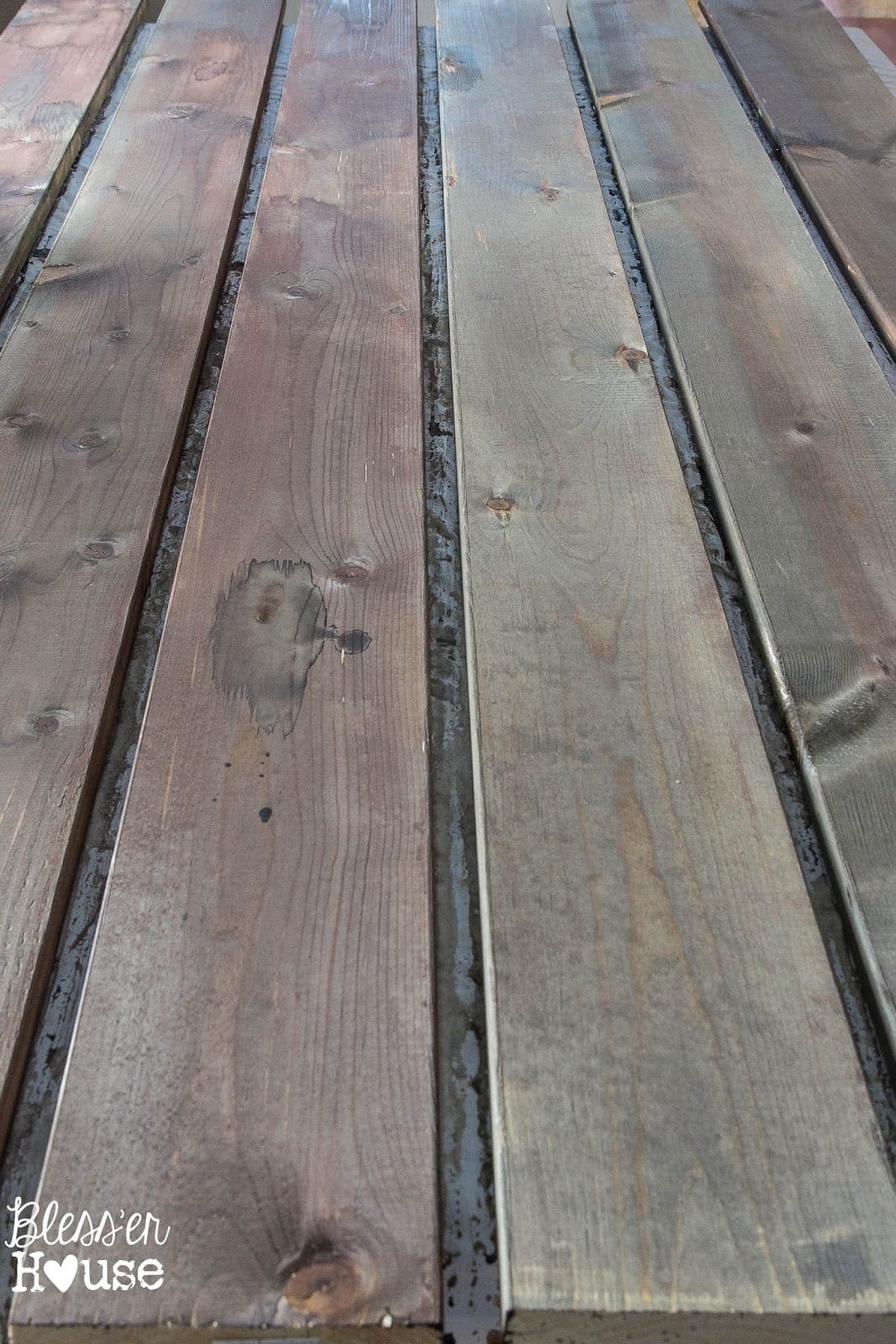
…and 1 hour, I had my perfectly aged wood. Insert fan girl squeal!
You will likely get a slightly different result on each wood board since this is a reactive finish that will all depend on how the tannic acid reacts to the solution. A commercial stain will give a more consistent result. This method is great for anyone who appreciates the natural variation of aged wood.
Considering it only costs about $5 for ingredients from the grocery store, it’s a steal for creating that distressed wood look!
There were a few spots I had to go back over and apply a little more of the oxidizing stain that left a few blotches, but I’ll sand them down a bit to even it out. And I think the imperfections give it a more realistic barn wood look anyway.
You most likely will not need a second coat of stain in order to achieve a dark color. But if you are looking to achieve a darker stain, you can apply an additional coat of the steel wool/vinegar solution.

Step 6 – Seal With a Top Coat
For the final step to seal in the color, apply a clear coat of wax with a lint free cloth or brush on a coat of polycrylic or polyurethane, especially if you are using the wood on a dining table top or coffee table or creating a weathered wood look in a high humidity space like a bathroom.
It almost reminds me of that glorious wood from my in-laws’ “magic barn” that I’m a bit infatuated with.
I’m so ready to get this plank wall up in our bathroom now! I might have to celebrate with something crazy like a science lab rocket launch. 😉
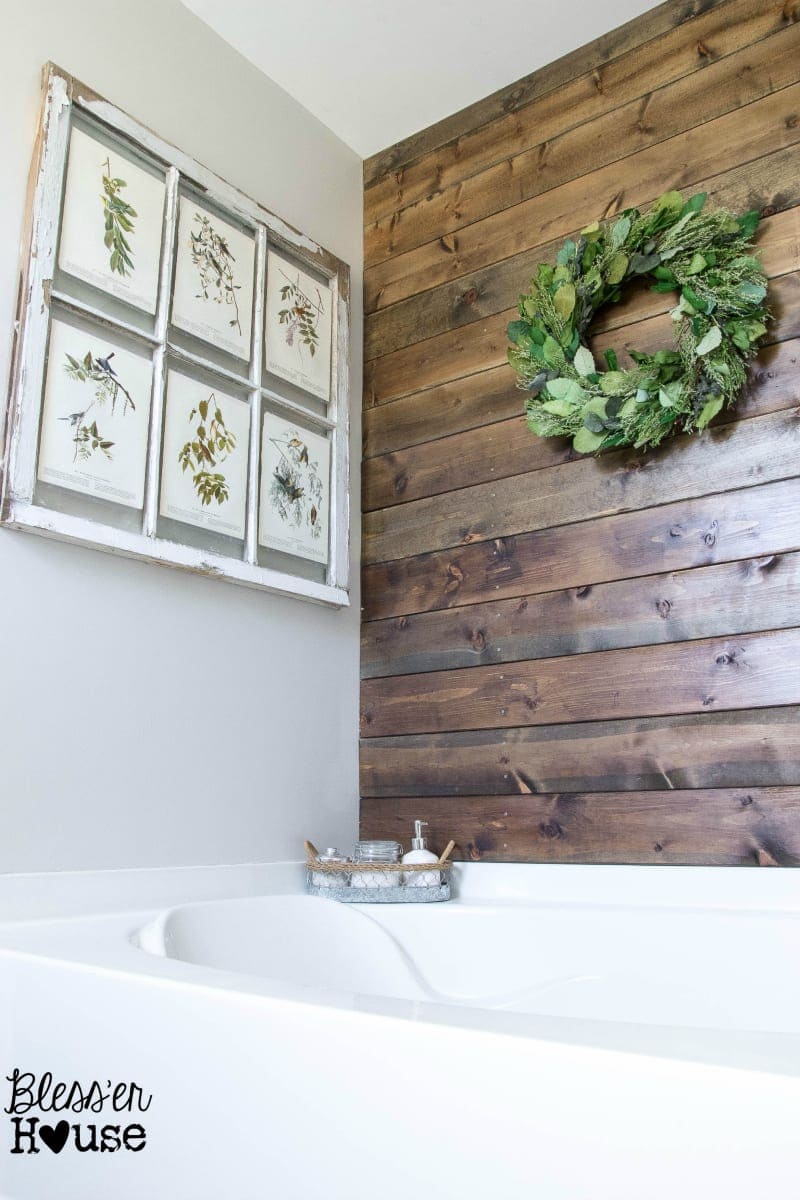
You can see how our DIY natural wood stained plank wall turned out here!
Shelf Life: The steel wool/vinegar homemade stain solution works best within 1-2 weeks since it can become less effective after a long time.
And we used the same staining method on our DIY wood beam doorway!

More Wood Project Ideas
Best Deck Stain Color for a Neutral Driftwood Look
DIY Faux Driftwood Outdoor Dining Table Makeover

How to Refinish Wood Furniture Without Stripping

How to Restore Wood Outdoor Furniture


Oh my gosh I love this idea. So I’ve sanded down a piece of my furniture & I’ve been letting my oxidation mixture sit for almost 24 hours now. BUT it’s not black like yours 🙁 should I mix it up or something before I use it?? I used steel wool & apple cider vinegar & everything. Help!
Hi Rexie! Did you apply the black tea first and let it set in? Without the tea, it won’t work. But if you have done the tea and the vinegar/steel wool step still isn’t working you might just have to let the solution dissolve for another day or two. The wood species can play a factor as well. My wood was pine if that helps. 🙂
I’m letting it sit now, & I Was wondering if I needed to stir it up or something because the vinegar isn’t black like yours was in the picture. I haven’t applied anything yet!
Hmm… Did you use #0000 grade steel wool? Sounds like you might have the wrong grade type.
Yes, I used the 0000 grade, maybe I just need to let it sit longer.
Darn! Okay, yeah I would stir it and just let it sit for another day or two. Make sure it’s sitting at room temperature too. That might play a factor as well. Hope it works out for you! Let me know if it still doesn’t work. So sorry you’re having issues with it.
Love this!!! I used this on my brand new crates that I wanted to age, they’re turning out perfect!!!! Thank you for this post! What would be best to seal them?
Awesome! I’m so glad it helped, Tiffany! I typically use matte polyurethane to seal it.
This is exactly the color I was looking for! I know I’m kind of late in finding this but I hope you can still answer my question. I bought all the materials to make the stain and I started it last night it’s been sitting 10 hrs, for the oxidation, did you just use one steal wool pad? I know the package comes with 12, I used one but I see no reaction. Like I said it’s only been 10 hours so maybe I’m being impatient! Lol
So sorry for my delay in answering your question, Adriana! I would just wait longer than 10 hours. Give it a full 24 hours and you should be good. I’m right there with you though on being impatient. That’s the one downside. It takes a bit of planning ahead of time to brew the stain beforehand. I just keep a plastic coffee container filled with some DIY stain in our garage, so it’s always there when I need to do a project on a whim.
Hi Lauren, I found your site when looking at Nancy (artsy chicks rule) and Christy (confessions of a serial diyer) – trash to treasure tuesday. I’ve spent hours looking through and love a lot of the products you guys use but it is near impossible to get them in Australia, except your stain haha cause I can make it myself. The question I have before I go hell for leather is can this be used on curved furniture (chair legs etc) and a timber bed frame or is it mainly for use on flat timber like the planks and coffee table top?
Thanks for any advice, I shall enjoy my reading.
Hi, DeDe! Thank you so much for all the love! I’m glad you’re enjoying my little corner over here! I haven’t really tried the stain on anything other than flat lumber so far, but I think it’s completely doable on any bare wood surface, even if it’s curved. I say go for it. 😉
Thanks Lauren. I’ve made notes on all the tips given, soon as the weather has cleared here in Australia I’ll give it a crack and let you know how it goes. Sorry I can’t send you a pic when I’ve finished due to personal reasons I don’t have social media other than email. If it works happy dance all round and watch out furniture.
Awesome! And I totally understand about the social media thing. Honestly, life would be much simpler without it. I’m a teensy bit jealous of your life unplugged. 🙂
I’m planning to try this out on a coffee table we made, but I was wondering what you suggest to make it a deeper brown, still with slight grey undertones? I was thinking more tea? Would you suggest a stronger brew, or perhaps more coats of the tea?
Hi Aelix! I would try a stronger brew of tea because that will make the tanins come out of the wood even more. Sometimes, after I’ve done both steps and I decide it’s not dark enough, I just brush on another coat of the tea and it will react on top of the vinegar/steel wool mixture to darken it immediately on contact. Try a tester to make sure first. Hope that helps!
Thanks Lauren! I’m starting to stain it this weekend, so I will try that out!! 🙂